
The experience of local authorities is that when you constrain the volume of waste that householders can set out – whether by banning side waste, reducing bin sizes, or cutting collection frequency – the effect is to reduce waste arisings. It is commonly assumed that much of this represents genuine waste prevention – householders cutting down what they throw away, perhaps through home composting, or just by using less. But how much is down to illegitimate commercial waste being diverted from the household stream?
Before going any further, I should say that I don’t know the answer to this question. There is a paucity of research on the subject, although the available evidence seems to point to widespread abuse of household waste services. In a 2010 survey, Defra found that approximately 40% of English businesses with fewer than 10 employees (“microbusinesses”) use household waste and recycling services to deal with their waste.
Of course, abuse of the system is an important issue, and we need to look at it, but a bigger question for me is how can we improve recycling among small businesses in a way that is legally compliant and doesn’t see local authorities out of pocket?
Domestic service
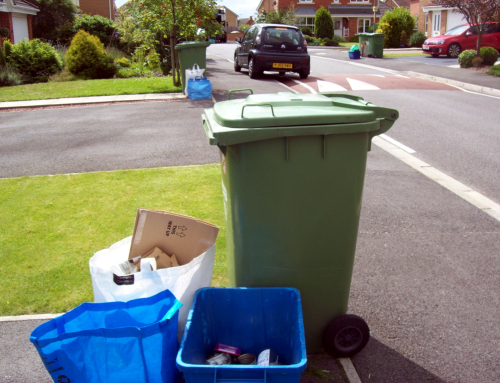
We are now achieving high recycling rates for household waste across many areas of the country through the implementation of well designed recycling systems. Where these same services are offered as part of a paid for commercial waste service, many small businesses do not sign up to them. This is, at least in part, because many such businesses do not produce enough waste to warrant paying for these separate collections – it’s simply uneconomic. Therefore the waste they produce is often deposited in the household stream, where there are good opportunities for this waste to be recycled.
For people running even quite substantial businesses like nurseries or B&Bs from home, there is also perhaps a natural tendency to assume that they can legitimately use their normal household bins to get rid of their business waste. Many, not being knowledgeable about waste, may be unaware that this is not permitted.
Which way to go?
So should the problem of microbusiness waste being illegally deposited in the household waste stream be tackled through enforcement and education? Could we legitimise the use of domestic services used by small and micro businesses, albeit with appropriate charging? Is there another way?
If we go down the enforcement and education route, and it is effective in pushing commercial waste out of the domestic waste stream, how can we expect these businesses, each producing small quantities of waste, to recycle if it means paying for several separate collections? Moving microbusinesses out of domestic services might actually lead them to recycle less.
Perhaps a better approach would be to somehow legitimise use of the domestic stream, requiring businesses to pay (perhaps a flat fee) for the material they dispose of. I think this has quite a lot of potential, but there are clearly issues to look into.
The real challenge is that there will always be a temptation for businesses to abuse household waste services where there is capacity to accommodate more than a householder produces, and where commercial waste disposal/recycling is charged incrementally. One way to change the equation would be to introduce a weight-based charge for household waste, but this is widely opposed. So what are the alternatives? I’d be interested to hear other views on this analysis and what else might work.




Hi Claire, just thought I’d highlight the really interesting discussion that this article has provoked on E2B Pulse:
http://www.e2bpulse.com/Forums/Messages.aspx?ThreadID=234429#new
Great that this article has really struck a chord.