
The Christmas break provided me with an ideal opportunity to reflect on the state of the world, although I fear some may call it a morbid preoccupation that is best avoided. Christmas, they might say, is about celebrations and rewarding oneself after a hard year’s work. After all, are we not all worth it? Do we not deserve to be spoilt? But I feel that reflection is now a necessity. We can no longer divorce ourselves from the environmental and social implications of our consumer lifestyles.
‘Tis the season to consume
After all of the gift-giving of Christmas, I spent the next few days hearing about the frantic rush to catch the winter sales, with some queuing desperately from the early hours of Boxing Day morning to make sure that they had the first shot at all the bargains. The West End of London alone is reported to have raked in £15 million in the first three hours of what has become “traditional” Boxing Day trading.

The philosophy of shopping
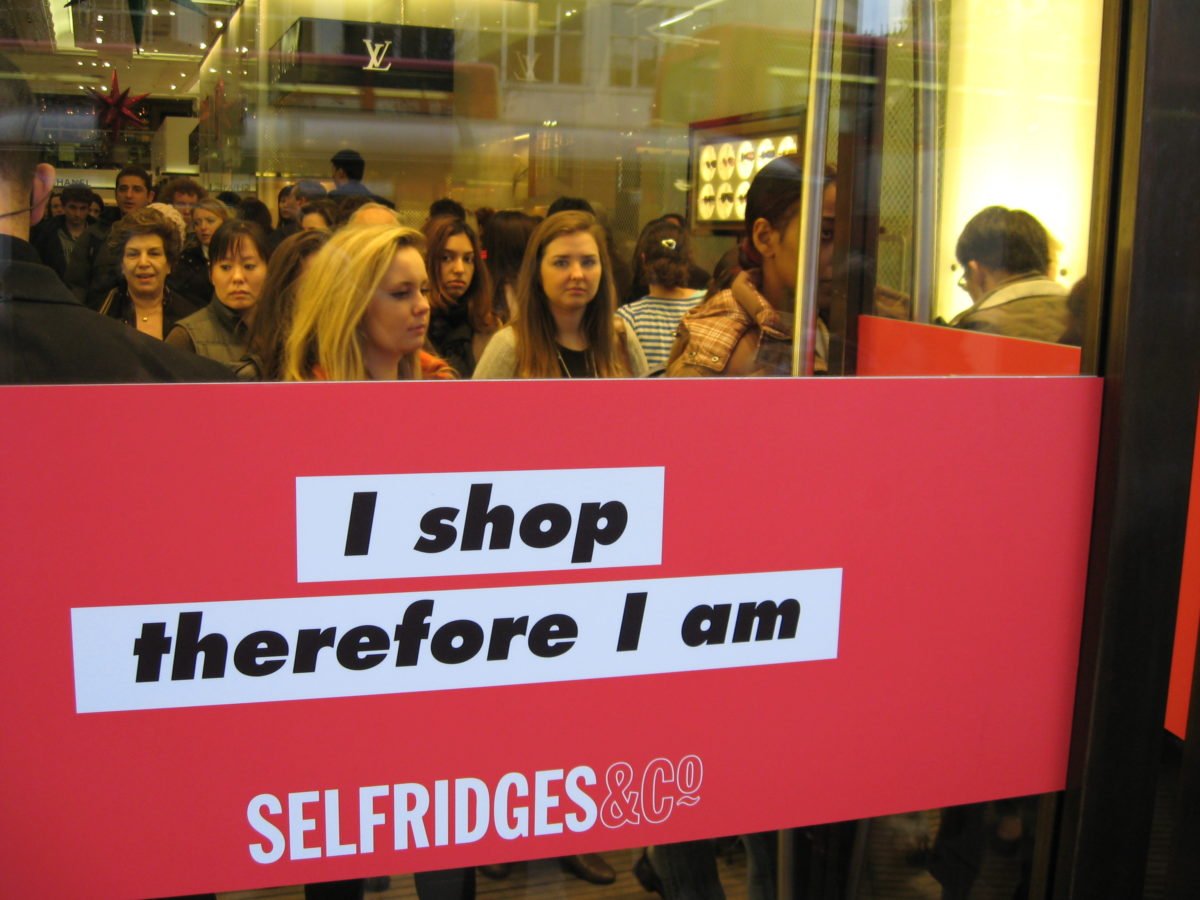
The department store Selfridges, playing on Descartes’ dictum, advertised its sale with the motto “I shop therefore I am” – suggesting that those not shopping are somehow non-people … a sad state of existential affairs, but perhaps not far off the mark in our current society. So strong is our drive to shop that, despite the economic climate, the store reported its single busiest period ever on Boxing Day 2011: £1.3 million worth of discounted goods were taken from their shelves in the first hour of trading.
Less shopping, more thinking
Tim Jackson, Professor of Sustainable Development at the University of Surrey, seems to agree that we’re becoming more defined by what we buy. He claims we are “locked into an iron cage of consumerism,” not only because it drives the economic growth that we demand, but because now more than ever our identities are defined by what we consume. Objects are not only very useful, but they also hold significant symbolic value. In a culture which does not actively promote, let alone encourage, self-awareness it is no wonder that increasingly “we are what we have and possess.”
Christmas now seems to be the time when society celebrates its obsession with consumption. But we can only consume as we do so long as the majority of the world remains poor. It has been estimated that if the entire world consumed resources at British rates we would require three planets to sustain our standard of living, and five if we all wanted to catch up with the USA. If disastrous resource depletion and pollution of the environment are to be avoided, our consumption habit is going to have to be broken.
There is a lot that can, and is, being done to improve resource efficiency – much of the work I’m involved in at Eunomia being a case in point – but what are we as individuals doing to reduce our use of limited resources? Is it not time that we take greater personal responsibility for the ways in which we live?
With governments desperately trying to promote consumption as a means of kick starting their economies, they are unlikely to quell our consumer desires. We may, therefore, be left to rely on ourselves – and what better time than Christmas to reflect on the complexities of our individual and collective consumer desires – and perhaps make some changes. Sharing this time with family and friends is also a perfect opportunity for some light hearted evangelical environmentalism – and perhaps to prompt some resolutions for the New Year. We don’t have to be defined by what we buy – let’s spread the word and reclaim our identities….





Thomas – this article has struck a chord with quite a few people. There’s been a bit of a discussion about it with users of WasteAM:
http://www.wasteam.co.uk/day-in-the-life-of-joddle/waste-reading.html/
and I thought I would add a link to an article mentioned there – poor on spelling, but an excellent match to your way of thinking:
http://davidreport.com/the-report/issue-9-2008-i-shop-therefore-i/
The New Economics Foundation (NEF) has been doing some very interesting work on the environmental and social benefits of shorter working weeks. They suggest that a 21 hour working week – sounds too good to be true – could go a long way to rebalancing our lives. With less money, but more time we will have to start perusing other leisure activities beyond ‘retail therapy’ and find meaning (and identities) in non-consumptive spheres. As with many things, however, the transition to such a scheme is all but clear. Although NEF do go some way to suggesting what may be required to bring about such a transition, there is naturally a long way to go…
The report by NEF can be downloaded here:
http://www.neweconomics.org/publications/21-hours
Phillip, that’s an interesting point – for the affluent in the West, the need to consume is symbiotic with the our wealth. A friend of mine explored this issue – and the way that reducing the amount that we work might have social benefits, in this article:
http://www.scottishreview.net/KirsteenShields190.shtml
Hope you find it an interesting read.
One dilemma in looking to achieve sustainability through individual action is the fact that on average we in the developed world are paying ourselves much more than we need to live a sustainable lifestyle. So the promotion of restraint is effectively urging us to decide not to spend the money we have. Unsurprisingly many people can’t see the point of that even if it only means foregoing stuff which they don’t really need.
A sane solution might be to work less hard and get paid a bit less so that we have more time for enjoying ourselves – but we still have to deal with the problem that for a large part of the population “recreational shopping” is what they do with their spare time.
Great article, Thomas!
It’s not just Christmas either. In the last few days, I got asked a number of times by various people what I got for my birthday, and when I reply that I got nothing people always give me weird looks or make some comment that implies they feel sorry for me. But the truth is that I’m glad. I’m glad that I didn’t get more stuff that I don’t want or need. I’m glad that I didn’t get more stuff that’s just going to collect dust on my shelves or end up as waste. I’m glad that my family and friends understand that I would rather get an email or facebook message than a ton of cards. I try to take these opportunities for a bit of what you call ‘light hearted evangelical environmentalism’ and to spread the word that we can all start reclaiming our identities back from consumerism.