
by Peter Jones
Can we say that we ought to protect the environment? Is there a moral obligation on us to do so? In other words, is environmentalism a branch of ethics?
This is a significant issue. If the environment is an ethical issue, failing to act appropriately amounts to a serious flaw – whether in an individual or an organisation – worthy of the same condemnation we might bestow on someone who steals, or behaves cruelly.
Getting intuit
One of the things that I find interesting about the question of whether environmental protection is an ethical issue is that intuitions on this point tend to differ. Some people find the idea of inflicting damage on the environment repugnant, while others remain largely indifferent. Can we say that one or the other is right?
Of course, there are plenty of other cases where people have different moral intuitions: the issue of abortion, for example. The further afield we look, whether in time or space, the greater the divergence: for example, the ancient Athenians, who gave us democracy, appear to have routinely abandoned or killed babies that showed any physical imperfection.
No matter how strongly we might hold our principles, exposure to the morality of different cultures makes it difficult to insist that our intuitions are somehow privileged. ‘Moral relativism’ is widely bandied about as a derogatory term – but the alternative to relativism is the improbable claim that we, uniquely, have grasped the moral truths of the universe.
Pleasure before duty?
In philosophy, ethical theories try to supply a rational basis for our judgements about right and wrong. The search for grounds more solid than our shifting intuitions on which to base our moral judgements has led to several competing theories of ethics.
- Consequentialism focusses on the effects of our actions. The right action is the one that leads to the best outcome: in the most famous formulations, the utilitarianism of Jeremy Bentham and John Stuart Mill, this amounts to whether they maximise pleasure and minimise pain.
- Deontological theories say that we act morally when we act in accordance with our duties. Immanuel Kant’s version of this is one of the best known: he argues that our duty is to behave in a way that you can rationally wish that everyone behaved – “Act only according to that maxim by which you can at the same time will that it should become a universal law.” If universalising the action leads to a contradiction (if no-one kept promises, there could be no promises) or an undesirable outcome (if no-one gave to charity, the outcome would be one that no-one would want) then the action is not moral.
- Aristotelian ethics consider ethical behaviour to be part of what it is to excel as a person. Cultivating virtues such as courage, honesty or compassion is what matters; if we’re good (at being) people, we will act in the right way.
Despite centuries of thought and refinement, no theory has emerged as pre-eminent; in their raw forms, all give rise to some pretty counter-intuitive conclusions. I suspect this is because our normal moral thinking takes account of character, duties and outcomes (amongst other factors); so focusing on one to the exclusion of the rest leads to results that we find bizarre. For example, we’re unlikely to accept that:
- it’s OK for one person to suffer terribly if a sufficiently large number of people are made a little happier as a result (as simple utilitarianism suggests); or
- it’s wrong to lie to an axe murderer in your house if they ask you whether your children are upstairs in bed (as simple deontological thinking suggests).
Popular thinking
The key point for this article is that all of these classical theories are concerned only with our actions in relation to other humans. But do they have to be? Peter Singer, for example, espouses the view that the pains of animals should be counted alongside those of humans in any utilitarian calculus. That position has profound implications on topics such as whether one should eat meat; whether it’s acceptable to test medicines or cosmetics on animals; and whether it is acceptable to wreck habitats. For deontologists, we could identify duties that relate to the environment (for example “one should not waste resources”) that could be universalisable in the way Kant suggests.
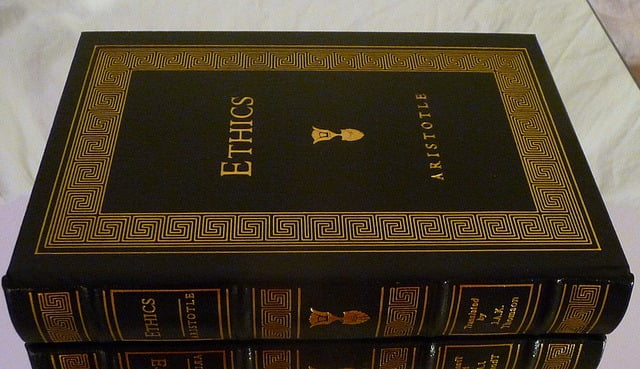
Should we throw the book at people who don’t care about environmental issues? Photo: Pamela Carls (CC BY 2.0), via Flickr.
But how might one convince a sceptic that we should extend the scope of ethics in this way?
- We could appeal to current human interests. For example, some argue that the Amazon should be conserved because it is a potential source of new medicines that might benefit us, while Marshall Islanders threatened by rising sea levels have a direct interest in campaigning for action on climate change. But there are relatively few cases where simple self- or local interest would motivate environmental concerns – at least not to a degree that would take precedence over other things people care about. Further, self-interest tends to be contrasted with moral behaviour, so makes an unpromising basis for an environmental “ought”.
- We might appeal to the interests of future humans, and argue that we should give weight to them when deciding what’s right or wrong. Other than for childless misanthropes, this idea is likely to have some motivational force. It would also extend the range of environmental issues that might fall into the moral sphere to include those with long term impacts. However, the further ahead we look, the more problematic this becomes. The folk who might (with luck) walk the earth 500 years from now aren’t just remote; they don’t exist! How should we weigh the interests of possible persons against the interests of those currently living? And considering how different our views are from the people of mediaeval Europe, can we even predict what our distant descendants’ interests might be?
- We might argue that people are not the only relevant concern, and that animals, plants, or ecosystems as a whole should be treated as having a value “in themselves”. Something is an end in itself if its value is inherent, rather than due to it being useful for some other purpose. Take happiness, for example: we don’t seek happiness in order to achieve something else, but for its own sake. Some philosophers argue that people should be regarded as “ends in themselves” and not be used as “a means to an end”; is it plausible that this could also apply to the environment? Probably not: the justification for giving humans special status is typically based on special characteristics that we have, and that other things lack – like self-awareness or the capacity for agency. Only people already convinced of the inherent value of the environment are likely to think it has value “in itself”.
So, if we appeal to current human interests, only a narrow range of environmental issues are of moral significance. If we take account of the interests of future humans, the range of issues broadens, but our confidence in our judgements decreases. And if we don’t appeal to human interests, we may only be preaching to the converted.
Ethical development
For me, it’s a frustration of philosophical ethics that theories also have to produce results that match our perceptions of what constitutes good and bad. If a theory produces surprising or counter-intuitive conclusions this is generally regarded as a flaw in the theory, not a problem with our intuitions.
For many people, much of the time, our intuitions are that human interests come far ahead of environmental concerns. There was international outcry when Cecil the lion was shot for sport, but would we have found his demise at the hands of a dentist so despicable had it been a situation of self defence?
To boost the importance given to the environment would require a social change, not just a good argument. That would not be easy, but the circle of things we’re prepared to care about has widened before. For example, slavery was commonplace and accepted for centuries, but is now widely considered to be terribly wrong, and cruel sports such as bear baiting would now be unacceptable to most of us.
Furthermore, we do condemn people who draw their circle of concern too narrowly:
- Someone who cares only about themselves we call a sociopath.
- Someone who cares only about their immediate family or surroundings, we call parochial.
- Someone who cares only for people of their race or religion we call a bigot.
- Someone who does not care about animals, we might call heartless.
What, I wonder, might be the right term for someone who does not appreciate the value of nature? Once such a word exists, humans will be on their way to believing that there are things beyond ourselves that have sufficient value to merit some level of self-denial on our part. At that point, the environment will have become a moral issue.




I’m not sure you can ever take the human element out of the moral debate – if there’s no humans about then there’s no moral debate to be had! For me it all comes down to how we value future generations. It’s about how we consider their rights against ours based on our best guess of what they’ll value. If we consider their rights as equal as ours (with no future discounting), then the consequential and non-consequential approach would come to the same conclusion; there is a moral imperative on us to protect the environment.
sure. You have written a very good articles giving ethical reasoning such as Kant. What’ s on my mind is simple, just as we clean up after picnics, it’s polite and considerate to keep our planet healthy and tidy. In some other cases I would like to compare environment protection to artwork. They are both useless in utility view but priceless in a greater extent.
I like the metaphors, but I’m not sure they get us that far. What counts as polite varies considerably around the world. Not all artwork is priceless. Most has a clear (often low!) value. Plus the environment provides us with many services that have a monetisable value (see Eunomia’s work on Payments for Ecosystem Services). Indeed, if all aspects of nature were priceless, and we were obliged to protect it all – wouldn’t the act of breathing (which delivers CO2 into the atmosphere) be immoral?
Brilliant. But doesn’t answer the question of how it is possible to nudge people into accepting responsibility for the waste they generate.
Hi John, I suspect that might be a job for a different article! Of course, there’s lots of that sort of work going on across the sector, and I’ve had a go at a few such nudges in the past – whether it’s thinking about waste at Christmas
https://www.isonomia.co.uk/?p=2597
or trying to counteract nudges in the opposite direction from the press:
https://www.isonomia.co.uk/?p=4310
Further ideas about how Isonomia could contribute – or indeed articles from readers like you – would all be welcome.
I think the appropriate term may be freeloader. It’s safe to assume very few people actively want to harm the environment. Those who don’t “care” are those who readily prioritize other things over the environment. In economic terms they are externalizing some of their costs (making others pay) in order to maximize their utility (often manifested as profits). This is clearly akin to freeloading and is clearly an ethical issue.
Hi Rog – I like your point about freeloaders, and certainly from the viewpoint of someone who cares about the environment, that would be an apt description of someone who doesn’t make an effort. But how does the world look from the other side? Wouldn’t the “freeloader” tend to regard the environmentalist as a “sucker”, who fails to maximise their utility for no good reason (assuming that the freeloader’s behaviour doesn’t have any immediate, appreciable negative impacts)?
There seems to me to be another issue, in that we humans living in cities are becoming more disconnected from nature. We do not see the interconnectedness of it or to our own existence as humans. Technology is disconnecting us from our nature.
If we destroy habitat we might destroy say a virus that in some way regulates another organism and so on up the chain. The removal of the virus may have catastrophic consequences with positive feed back.
And does the same apply to climate change? Is the ecosphere going to changes in such a way that humans can no longer exist or we evolve into something totally unrecognisable. The ecosphere is a large balance system, how big a step function can it absorb without going uncontrollably unstable?