
One of the less remarked upon but highly significant changes announced in the Chancellor’s Autumn Statement was a simplification of the Carbon Reduction Commitment (CRC). While the changes may appeal on the grounds of a claimed £272m reduction in compliance and reporting costs, they do nothing to stimulate renewed interest in on-site renewable energy generation by businesses, and need urgent revision if they are not to act as a disincentive.
Under the CRC, which aims to promote energy efficiency and cut CO2 emissions, major energy users are required to buy carbon emission allowances each year. It was originally intended that the incentives would be increased through a system of bonus payments to the top performers and penalties for the most energy intensive, but all money raised is now being kept by the Treasury.
FIT for purpose?
Improvement to the CRC is certainly overdue – the illogical regulations have too long taxed renewable electricity that businesses generate on site for their own use exactly the same as grid mix power. All electricity consumption is tax is based on the average carbon emissions of the overall grid mix, regardless of how the energy consumed is in fact generated. Businesses are faced with a choice – either pay the tax, or give up the Feed In Tariff (FIT) or Renewable Obligation Certificate (ROC) subsidy for the electricity they generate.
The justification is that the CRC is intended as a spur to energy efficiency, not to low carbon energy. So, to avoid giving a double benefit to those generating their own renewable power, energy for which a FIT or ROC is claimed is treated as if sold to the relevant renewable support mechanism and isn’t eligible for a CRC Energy Generating Credit (EGC).
Given that the value of the ROC or FIT sacrifice will be much higher than the CRC saving from the EGCs, most businesses will choose to accept the tax liability. However, by offsetting against the ROC or FIT, the CRC in effect reduces the incentive to generate local clean energy. Ironically the same disincentive does not apply in relation to the Renewable Heat Incentive (RHI), even though it is a very close parallel to ROCs and FITs.

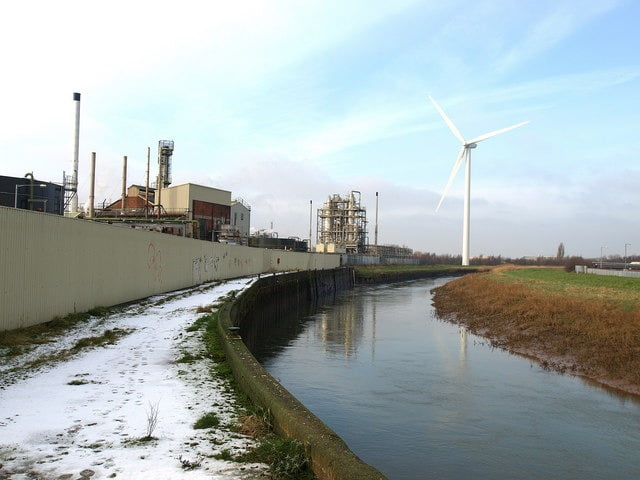
On site generation needs the right incentives. Picture by Andy Beecroft, via Wikemedia Commons
When the CRC was introduced, controversy over the disincentivisation of self-generation led to the creation of a performance league table, which at least enabled industry to report the benefits of on site renewables for corporate social responsibility purposes, even if their CRC tax liability was not affected. However, one of the Autumn Statement simplification measures was to abandon the league table, removing even this minimal reputational benefit from those producing renewable electricity for their own use.
Praseg be!
Understandably, this initially caused some consternation! However, the Department of Energy and Climate Change (DECC) has taken steps to provide some much-needed reassurance. First they issued a press release on 10th December 2012 that stated: “Government will consider how the CRC can incentivise the uptake of new onsite renewable self-supplied electricity.”
Then on the 12th, Minister of State Greg Barker told the Parliamentary Renewable and Sustainable Energy Group (Praseg): “I am in the process of consulting with Treasury”. Though a little woolly, these comments are still to be welcomed.
The simplification measures also provide one reason for optimism regarding on site renewables. The reduction of CRC reporting obligations to cover only two fuels – electricity and gas (assumed to be for heat) – will focus attention on how to cut consumption in these areas, and business may show renewed interest in on site generation if an adequate incentive is in place.
Off the grid
I would argue the need for urgent measures to allow carbon saved from renewable electricity to reduce CRC tax. The simplest approach would be for renewable electricity not to be taxed based on the overall grid mix, but to treat it in exactly the same way as renewable heat produced under the RHI.
Defra and Treasury might resurrect objections relating to the double counting of carbon savings, as there would be a small distortion to the overall grid mix statistics shown in the statements utilities are required to provide to customers. There is however a geeky solution to this, involving the often overlooked REGO certificate of renewable energy generation origin. These certificates are primarily used for energy mix reporting purposes, with one being issued for every MWh of renewable electricity produced.
If a business wanted the full carbon saving reflected in its CRC calculation it would not pass on the REGO to the electricity supplier under the FIT or ROC power purchase agreement. This would reduce the renewable mix of electricity of the supplier thereby avoiding double counting.
It would also have the benefit over time of establishing a market price for the renewable content of electricity, as slightly different prices would be likely to emerge for brown power plus REGO plus ROC compared with brown power plus ROC alone. In the case of the FIT, a standard adjustment could be made. Longer term this would be helpful to the industry, come the day when incentives go entirely, ensuring that renewable electricity prices do not collapse to the brown-only price. (These arrangements would not affect the similar but different levy exemption certificates which ensure renewable power is exempt from the climate change levy).
As the majority of on-site installations are likely to be solar PV or small-scale wind, the reforms I am suggesting would not cost a great deal but would give a much needed fillip to the installer industry, which has endured a rollercoaster ride of late. It would also encourage businesses to take direct action in moving to a low carbon economy, by directly connecting investment in on-site renewables with downstream benefits. The key thing is to push on the door that has been pleasingly opened by DECC and Greg Barker and ensure that their consideration and discussions flow through to a real, effective incentive scheme that will promote investment in on site renewable energy generation and create green jobs. In time, thought could also be given to providing similar exemptions for businesses owning remote renewable sources –providing they also purchased the output for their own use.
A version of this article first appeared on the Renewable Matters website, which also has available the Climatechangematters report High energy users and renewables. This suggests a number of other regulatory changes that would facilitate business participation in the low carbon economy.






On this occasion, I think the Treasury position is logical. While renewables remain a small – but growing- proportion of our total energy mix any wasted electricity whether from renewable or brown sources has to be replaced by additional brown energy. So the system is right to incentivise efficiency as well as generation, since i believe both are vital to deal with our carbon challenge. There is a separate question of whether the FIT or ROC payments are sufficient to promote on-site generation, but that applies to all not just those covered by the CRC.
In principle there is an additional benefit of on site generation in that the company does not have to pay the utility supplier for the energy they make themselves. But as I discovered when I was negotiating climate change levy agreements a decade ago, the way in which the big users pay their energy supplies is not simply related to the units consumed but to their negotiating strength. Those arrangements may be a much bigger hurdle to the investment case for on site generation.
I haven’t been following the RHI so closely – but on the face of it the different position taken on that also seems plausible since we don’t have a heat network spare heat can’t be exported generally.