

If pub conversations and online comments are anything to go by, everybody seems to know someone whose friend works in waste. And inevitably, with unimpeachable authority, that friend of a friend has let slip the unspeakable ‘truth’: recycling is a waste of time – it all ends up in a landfill anyway.
Pre-disposal?
To me, this always seemed like Chinese whispers at best, enthusiastically greeted and repeated by those predisposed to distrust their local council, or with an agenda to push . Then I met at first hand my own sceptical insider. I was hovering at the bar of a tiny country pub and chatting to the man to my right who had, he said, just finished a ten-hour shift at the local recycling centre. When I told him that I worked for a company involved in recycling, he gave me a grave look and beckoned me closer; ‘I don’t want to get into trouble, but you should know that it’s not all what it claims to be on the tin’, he said. ‘All the plastic bags that come our way, they go straight to the landfill. It’s all about money, and there’s no money in plastic bags.’
I’m new to this game, so I perked up at this information. This was an inside source from a recycling centre, blowing the whistle on what he claimed was malpractice. He told he would send me photos to prove it, so I scribbled my phone number on a beer mat and then left him to his pint.
On Monday morning, I looked up his council’s website. In big, bold letters, they listed the things they are ‘unfortunately not able to take’ for recycling; among them, plastic bags. Of course, that leaves open the question of why the council doesn’t offer this service (which I’ll return to). But while my source was right – carrier bags are being landfilled – his “leak” was hardly a scandalous revelation, just something that anyone with 30 seconds and a search engine could find out.
Mythed opportunity
He was also right that money is an important consideration in waste management. Councils generally ask people to sort those materials which it makes financial sense to recycle, and the most obvious reason that material which householders diligently separate for recycling doesn’t routinely end up in landfill is how expensive it would be. Landfill tax is over £82 per tonne and rising with inflation, and typically there’s a gate fee of £15-20 per tonne on top. The UK now incinerates more municipal waste than it landfills, but median incineration gate fees are also around £100 per tonne.
Most separated recycling (paper, card, plastic, cans), on the other hand, has a significant sell-on value, while sending co-mingled recycling for sorting is much less costly than disposing of it as residual waste. Why would increasingly cash strapped councils ever choose to pay to dispose of material when they could be paid to recycle? In general, it is as simple as that, with simple economics dictating that what can be recycled won’t be sent for disposal.
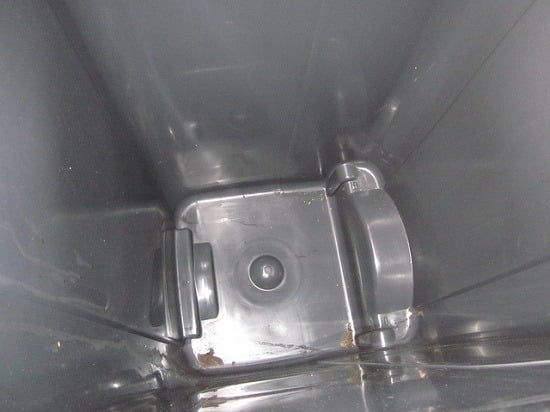
We aim to get to the bottom of myths about bins. Photo: Alan Stanton (CC BY-SA 2.0), via Flickr.
What’s true for waste in the UK also applies when recycling is exported. What Chinese businessman would pay to ship recycling all the way from England purely for the pleasure of burying it in a landfill?
Myth-reporting
So where do the rumours to the contrary come from? They seem to have origins in five commonly reported errors.
- Misunderstandings about what is “recyclable”: my barroom informant isn’t the only one to get mixed up about this. Materials like plastic bags, polystyrene packaging and paper coffee cups can in theory be recycled, but for logistical and economic reasons the economic case only really makes sense when clean material is available in quantity. That won’t be the case for post-consumer household waste, and so for most councils these are impractical materials to collect for recycling, whether at the kerbside or at the tip. Some newspapers seem to think that anything that gets put in a recycling bin should be recycled, but when people put the wrong things in they will need to be removed somewhere along the line, so that the rest can be reprocessed successfully.
- Misunderstandings about council services: I recently read that “Rubbish sorted for recycling in Sevenoaks is being burnt in an incinerator rather than reused.” As it turns out, the reality was that at one civic amenity site, a special arrangement was put in place over Christmas so that people could bring their recycling in rather than wait for the next bin collection. Ordinarily, there isn’t space for a recycling container on the site, but over the festive period little garden waste gets dropped off, so some space is changed over to dry recycling. When a few residents brought recycling to the dump in late January, the service had switched back to normal, and the only options available were to put the recycling in the residual waste – or to take it home and put it in the recycling bin. There were no false pretences, and no routine practice of incinerating recycling.
- Misunderstandings about transfer stations: You often hear that rubbish and recycling lorries all go to the same place. That can be true, but as long as the depot or transfer station has bays where different materials are kept separate, that’s no evidence that they all end up together in landfill.
- Misreporting of studies: A number of newspaper stories about recycling being landfilled in the UK and overseas have originated in misinterpretations of a WRAP report about UK materials reprocessors’ attitudes to material originating from UK MRFs. This mistake has been analysed here.
- Unusual situations being remembered as the norm: Demand for recyclables is volatile, and prices rise and fall in line with the commodities. Occasionally, it has been difficult to find markets for recycling. Even in this situation there is little evidence of recyclables heading for the landfill or incinerator. Rather, when prices crashed in 2008, there were rumours that ‘huge waste mountains could be sited on military bases under emergency plans to protect Britain’s recycling revolution from the economic downturn’. Things never actually got that bad, but for a time it was a real concern.
The myth that material the council collects for recycling routinely and wrongly ends up in landfill is strangely persistent: a Chinese whisper that just won’t go away. I think I’ve traced it back to its sources – but I’d be glad to hear from anyone who has other ideas about its origins, or other examples of stories that can be examined.




Hello Luke, you say below that ‘councils are required to list end destinations for their waste and recycling’. Where can one find this information? Is it available to the public?
The information is publicly available, but not in a very user-friendly form – it can be downloaded as part of the data available here: http://www.wastedataflow.org/
Some councils will publish their end destinations, so if you’re interested in a particular example, you could check their website or write to them. Here’s an example: http://www.northlincs.gov.uk/bins-waste-recycling/recycle-at-home/end-destinations/
If you’re interested in Wales, the Government has published a study of recycling end destinations: http://gov.wales/topics/environmentcountryside/epq/waste_recycling/publication/end-destinations-review/?lang=en
Hope this helps!
why is my waste being sent 13000 miles to china to be incinerated,please contact me as I have much to tell you about waste in the business for 20 years ,
Hi John, I’m not sure where you live, but I’m not aware of any UK local authority shipping waste (let alone separated recycling) to China for incineration. Some councils now use incinerators on continental Europe for their residual waste, but that’s because these nearby facilities can compete on price and want the fuel. I can’t think that China’s in the same boat, as it were. Maybe you’re referring to China incinerating contaminants extracted from recycling or material that isn’t economically recyclable – in which case, in my view this is significantly different from a scenario where recyclables are deliberately sent for disposal – the myth Luke addresses here.
I read that a high proportion of paper and plastic waste is exported. How do we know that the final destination is not a CHP incinerator in Holland ?
Hi Ian, It’s a fair question, but I think it has a fair answer.
The first part of it is economic – you have to pay to put waste through an incinerator in Holland, whereas you get paid for recyclable paper and plastic, so there is absolutely no incentive to go to the trouble of collecting these materials separately/separating them at a MRF and then to burn them.
The second aspect is the data: for local authority waste, councils are required to list end destinations for their waste and recycling, so if recycling were routinely ending up in incinerators, it would be identifiable through WasteDataFlow returns. I haven’t seen any evidence of this going on. And of course, material that was burned would not be able to be counted as recycled.