
On 28th March the Environment Agency carried out a ‘day of action’ against waste crime, code named Operation Cyclone. Over 100 officers visited 60 sites suspected of carrying out illegal waste actions in the North East and South East regions of England. In addition to site visits, roadside stop and searches were carried out. In 2012 the Agency stopped a total of 1,135 illegal waste sites including closure, enforcement action or advice on changing practices to operate legally. It is encouraging that the Agency is taking waste crime so seriously and having a real impact. However the large number suggests that for many operators the rewards of working outside the law remain attractive.
The number of illegal waste sites is (in Donald Rumsfeld’s terms) a known unknown: however, the amount of enforcement work carried out by the Environment Agency hints at the considerable scale of the problem, as does the fact that the number of known illegal waste sites doubled in 2011/12 and is expected to rise further as the Agency carries out more work in this area.
Criminal damage
Illegal waste sites fall into three main categories: those with a permit but violating its terms; those without a permit, but carrying out activities that would be lawful if they had a permit in place; and those acting in ways that it would never be possible to obtain a permit for (e.g. a landfill site in a geologically unsuitable area. The Environment Agency characterises the range of behaviour and how it aims to respond in a helpful diagram (see Figure 1).

Figure 1 – Environment Agency characterisation of waste sites and responses
The potential for environmental damage can be considerable. Land can become contaminated from the dumping of toxic chemicals and rivers and watercourses can become polluted, threatening both the natural ecosystem and human health. Unabated burning of controlled or toxic materials, whether deliberate or (more commonly) the result of stored or abandoned waste catching fire), harms air quality and causes problems for those living nearby. The Environment Agency has determined that many illegal waste sites are within 50 metres of schools, homes or other “sensitive receptors”.
Days of action such as Operation Cyclone are important terms of raising awareness of the problem, but are they effective in stopping it? Much of the literature on the motivation for criminal behaviour takes the view that criminals are rational thinkers who operate their criminal enterprises like businesses. Gary Becker’s 1968 paper Crime and Punishment: An Economic Approach argues that criminals will only participate in crime if it is lucrative: that is to say, if the expected value of the crime is greater than the expected cost to the criminal, pricing in any additional “operating costs” from prosecution, such as fines or imprisonment. Only if the enforcement “costs” make the crime financially unattractive will the criminal be deterred by them.
Ed Rubenstein continues from Becker’s theory by trying to estimate the cost to the criminal of the risk of prosecution. Taking the example of burglary, he applies the following statistics:
- 7% of burglaries in the US result in an arrest
- 87% of arrests lead to prosecution
- 79% of those prosecuted are convicted
- 25% of those convicted are sent to prison.
Multiplying the percentages, he concludes that only 1.2% of burglaries result in time in prison. Since the average period “inside” for those sentenced to imprisonment is 13 months the overall average per burglary is 4.8 days of prison time. This, Rubenstein argues, is the enforcement cost to the prospective burglar. Put in those terms, it doesn’t sound like an immense disincentive, although it is unclear how high a negative value a burglar would place on a day spent in prison.
Rubenstein’s approach is, if anything, more plausible if applied to waste crimes, which are primarily economic in nature. People operate illegal waste sites because the entry barriers and the risks of getting caught fairly are fairly low compared with the rewards. Many of the offences detected result in a ticking off from an enforcement officer or perhaps a fine. I wouldn’t claim that each individual participating in waste crime calculates the likely “cost” to them of enforcement action, but across the illegal waste sector as a whole, the balance of risk and reward seems likely to have an impact.
Becker and Rubenstein’s work highlights that in order for enforcement to be effective in dealing with waste crime, there are two main levers to be adjusted: the perceived chance of detection and the expected penalty if detected. Increasing either will decrease the profitability of waste crime by increasing the expected “cost” to the criminal of enforcement action.
Fine isn’t good enough
Actions such as Operation Cyclone are a good way to increase the perceived risk of detection, but without adequate penalties this will not be enough. Fines for waste crime averaged just £6,855 in 2011 with the highest fine just £17,000. Considering the level of income that can be made in a market where non-inert waste now typically costs over £90 per tonne to dispose of legally, these fines seem low. It would not be surprising if those who choose to break the law deem such penalties as simply an operating cost rather than a serious deterrent against operating illegally.
However, the Environment Agency has started to make use of other tools to increase the severity of sanctions. The Proceeds of Crime Act (POCA) came into force in 2002 and has recently been employed by the Agency in the prosecution of several illegal waste site operators. The aim of the Act is to take back from offenders the money they have made through acting illegally, and rebalances the burden of proof against the criminal. Once an individual has been convicted, the Agency can submit an estimate to the court of the criminal’s illegal income. The onus is then on the defendant to show that the estimate is inaccurate, or they will have to pay back the full amount. The result has been some impressively large sums. In May 2012, Hugh O’Donnell was ordered to pay £917,000 representing the income made from operating an illegal waste site and warned he would face four and a half years in jail if he failed to do so.
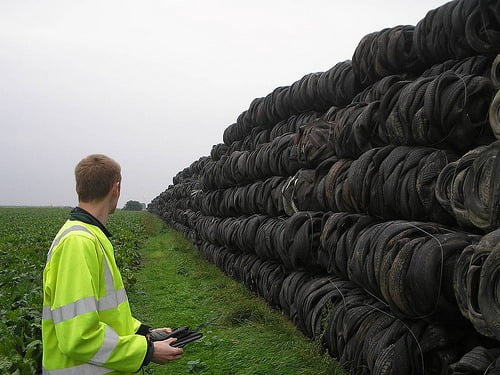
Dealing with illegal waste sites can be very tyring. Photo: Environment Agency
POCA has increased the size of penalties the Environment Agency can impose. Operation Cyclone shows that it is proactively working to locate those in breach of the law. Austerity may however bring a new threat to effective enforcement. Much of the Agency’s funding for tackling waste crimes comes from grant in aid from Defra and BIS, not from its income from permitting which is used to finance officers who monitor businesses holding environmental permits. Both departments saw substantial additional cuts to their budgets can be expected to pass on some of the cuts to bodies they work with. There is a risk that, with its resources ever more stretched, the Agency may not be able to continue such pressure on illegal waste sites, despite the relatively high profile it has as part of the Agency’s corporate scorecard. My question is however, is whether such cuts would really save money.
Faced with cuts, the Agency may have less scope to undertake proactive work to try to sever the roots of the illegal waste industry. Officers are currently visiting waste producers to remind them of their waste Duty of Care including their responsibility to check the destination of their waste. Its task force for dealing with illegal waste crime may not be able to undertake as many operations or resource them so as to maximise the chances of successful prosecution. Such changes will again shift the balance of our equation with a lower risk of detection offsetting the higher cost to waste criminals imposed by POCA.
Within the legal waste sector, the “polluter pays” model works reasonably well, as the income from permits pays for inspection and enforcement. However, for those acting without permits, enforcement funding depends on Government priorities. The Environment Agency’s enforcement activity needs to be protected, and it is in the interests of the majority of the mainstream waste sector to push for this – although those involved in the costly remediation of the damage caused by illegal waste sites may have a more nuanced view. One approach would be to ring-fence funding, although this may be unattractive to a Government set on austerity. Another would be to ensure that more of the money recovered through POCA is dedicated to enforcement work, although this might skew the Agency’s priorities to focus on cases where the financial rather than the environmental benefits are greatest. More controversially, the costs of illegal waste enforcement could be paid for through a subscription from businesses – perhaps limited to the waste sector, or across the board as an aspect of their waste Duty of Care.
The alternative to paying for proper enforcement is not just an increase in environmental damage and health risks due to illegal waste. With the profits to be made from undetected waste crime, it also means an upsurge in illegal waste operators undercutting those doing the right thing.





Leave A Comment