
by Peter Jones
Did you enjoy yourself this Christmas? I hope so – but isn’t it strange what enjoying ourselves means? For many of us, enjoying Christmas is all about consumption and excess. We buy and receive generous – even extravagant – gifts. We eat and drink far more than normal. We battle traffic, weather and hordes of other festive travellers, undertaking long journeys to see relations who we may not have visited for months. While we nurse our hangovers, overdrafts and carbon footprints, perhaps it is a good time to reflect on waste, excess and the possibility of doing something about it.
In the run up to Christmas we see the odd news article reflecting on the waste that goes along with the festivities. Often they’re based on statistics about the amount of material that gets thrown away at Christmas, and most either encourage us to recycle or perhaps call for reductions in packaging. Despite their good intentions, these pieces are pretty banal. Learning that “the amount of Christmas waste we’ve all produced would fill Big Ben 1,500 times” make for pub quiz trivia, but large, contextless numbers only take you so far. How many Big Bens do we fill in a normal week? Do we see recycling go up proportionately, or do we get lazy and stop separating our waste at this time of year? It may be valid to complain that some packaging is excessive, and sensible to urge that we keep up our recycling efforts at Christmas, but these points apply just as much all year round. What kinds of waste are specific to celebration, and what can be done about them?
Over-consumption
The tradition of celebration through excess is far older and more ingrained than Christmas. It appears that feasting dates back 12,000 years, the evidence for which, ironically enough, is the waste created. The residual waste arisings from the earliest identified blow-out were 71 tortoise shells and the bones of three cattle, which were recently found in Israel. How far this departed from the normal pattern of consumption for Stone Age man is unknown, but it appears to indicate the great antiquity of the practice of gathering together and eating more than we normally would. This, I think is the underlying and unavoidable form of “waste” involved in any celebration – every feast is in a way “excessive”, going beyond what is needed for sustenance. To that extent it is necessarily “wasteful” of resources, even if everything that is prepared is consumed by festive revellers.

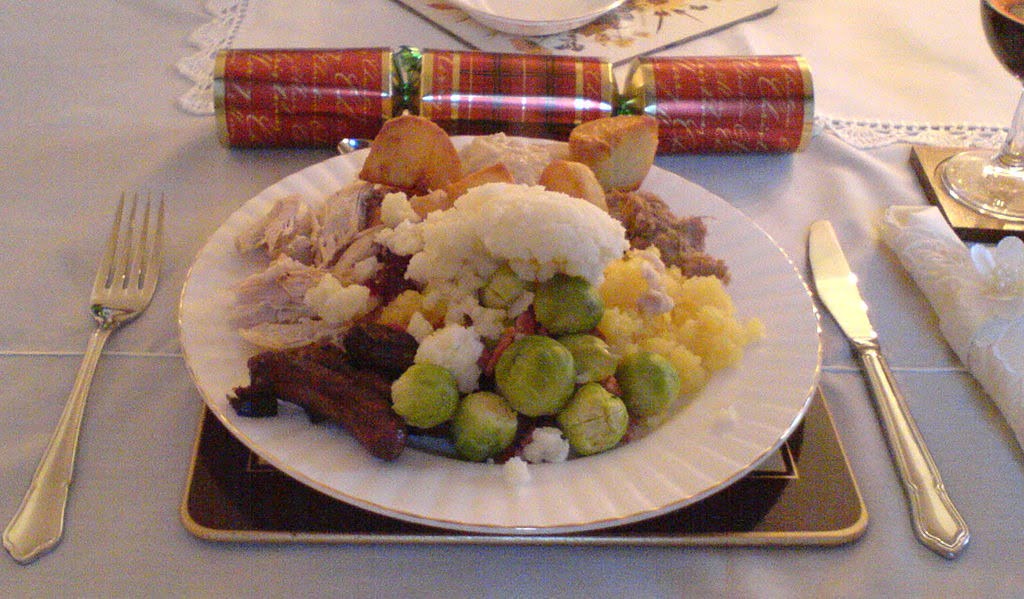
Christmas over-consumption in action. Picture by Qualit-E, via Wikemedia Commons.
While we could all think more about whether we really need that second helping of tortoise or third mince pie, a certain amount of over-consumption is part and parcel of festivity. The modern Christmas has a rather larger footprint, but continues the practice of marking important dates and major life events with fulsome feasts and generous gifts. The deeply entrenched social significance of this behaviour is perhaps behind the peculiar feeling one gets when suggesting that waste at Christmas might be reduced. Pointing out the excess and its harmful consequences for a society that is already in debt, overweight and grappling with how to improve waste management seems pretty curmudgeonly when set against the power of a tradition this strong.
Over-provisioning
However, Christmas is now so heaped with expectations that it gives rise to a second form of waste – that of over-provisioning. Nobody who organises a Christmas dinner wants to leave their guests unsatisfied, and the temptation when buying and preparing food will always be to err on the side of excess. But we seem to be erring by an ever larger margin – the Guardian this Christmas quoted WRAP’s extraordinary numbers on festive food waste “We throw out the equivalent of 2 million turkeys, 5m Christmas puddings and a truly shocking 74m mince pies…. To put it into context, that means we are binning nearly twice as many mince pies as retail giant Marks & Spencer sells every year (40m).”
Overprovisioning has two complementary aspects. Some food is “overstocked” and will be binned without ever being cooked or served; other waste will arise when we put more on our plate than we can actually eat. This “over-loading” is the natural concomitant of over-stocking, the reaction of those faced with the challenge of a mountain of food.
To an extent, over-provisioning is the inevitable consequence of festivity, but you don’t have to be a Christmas killjoy to think that more careful planning could cut this form of waste dramatically. (Pre)history does not record how many of those 71 tortoises were surplus to requirements, but I doubt that the ancient people of Galilee were dining on turtleburgers for days after the event. Perhaps it is the easy availability of cheap food and the deep-rooted desire to ensure that everyone gets to eat what they want that leads us to over-provision to an extent that our thrifty ancestors would have found hard to countenance.
Over-giving
No wonder most seasonal anti-waste articles stop short of adopting a full-blown “Bah humbug” view. While we may be against waste, who wants to be a party pooper? An outstanding exception, though, comes from the broadcaster Martin Lewis, who is also the creator of the website moneysavingexpert.com. It’s hard to go further in the Scrooge direction than to say “It’s time to ban Christmas presents” but Lewis’s argument starts from an analysis of the tradition from which our Christmas gift giving is derived.
Lewis explains “ceremonial gift exchange” as a form of social banking: people coming of age or getting married receive gifts from their friends and relatives that help them get started; as they become established and secure, they have the wherewithal to bestow gifts on the next generation of newly-weds and young adults. In this form, Lewis says, it is “an efficient method for society to focus cash on when and where it is needed.”
Our Christmas exchange of gifts now substantially departs from that time-honoured model, with many exchanges taking place on the following pattern. “David gives Nick a £40 blue tie for Christmas; Nick gives David a pair of £40 designer orange socks. The net result … Nick has spent £40 and got a blue tie; David has spent £40 and got orange socks. Effectively, you pay to receive someone else’s choice of object.”
If Nick is less well off than David, the perceived obligation to provide a gift of roughly equal value to David’s may well be a burden he doesn’t need – he could make better use of his £40 than paying for David’s choice of tie. Worse still, the obligation means that many of us receive gifts for which we have little use. Some clutter up our cupboards, some go to charity shops, and some find their way into the waste stream.
The social pressure created by this pattern of reciprocal gift-giving is hard to throw off as individuals or families – who wants their kids to be the ones who have to tell their school friends they got a walnut and a tangerine for Christmas? But Lewis suggests a number of practicable ways in which wasteful over-giving can be tackled, such as doing a family Secret Santa, setting gift limits, or agreeing non-present pacts with certain friends and relations.
I know that I for one have participated in all of the kinds of waste I’ve highlighted here, and I don’t for a minute underestimate the difficulty of reducing waste without cutting back on festive fun. However, while the afterglow of Christmas is still in evidence, might this be the ideal time see if we can loosen the shackles of tradition in advance of next December? Why not send this article or Martin Lewis’s round to a few friends and relations to start the discussion while the turkey burgers (or turtle, if you’re an ancient Galilean) are still on the menu?





Leave A Comment